
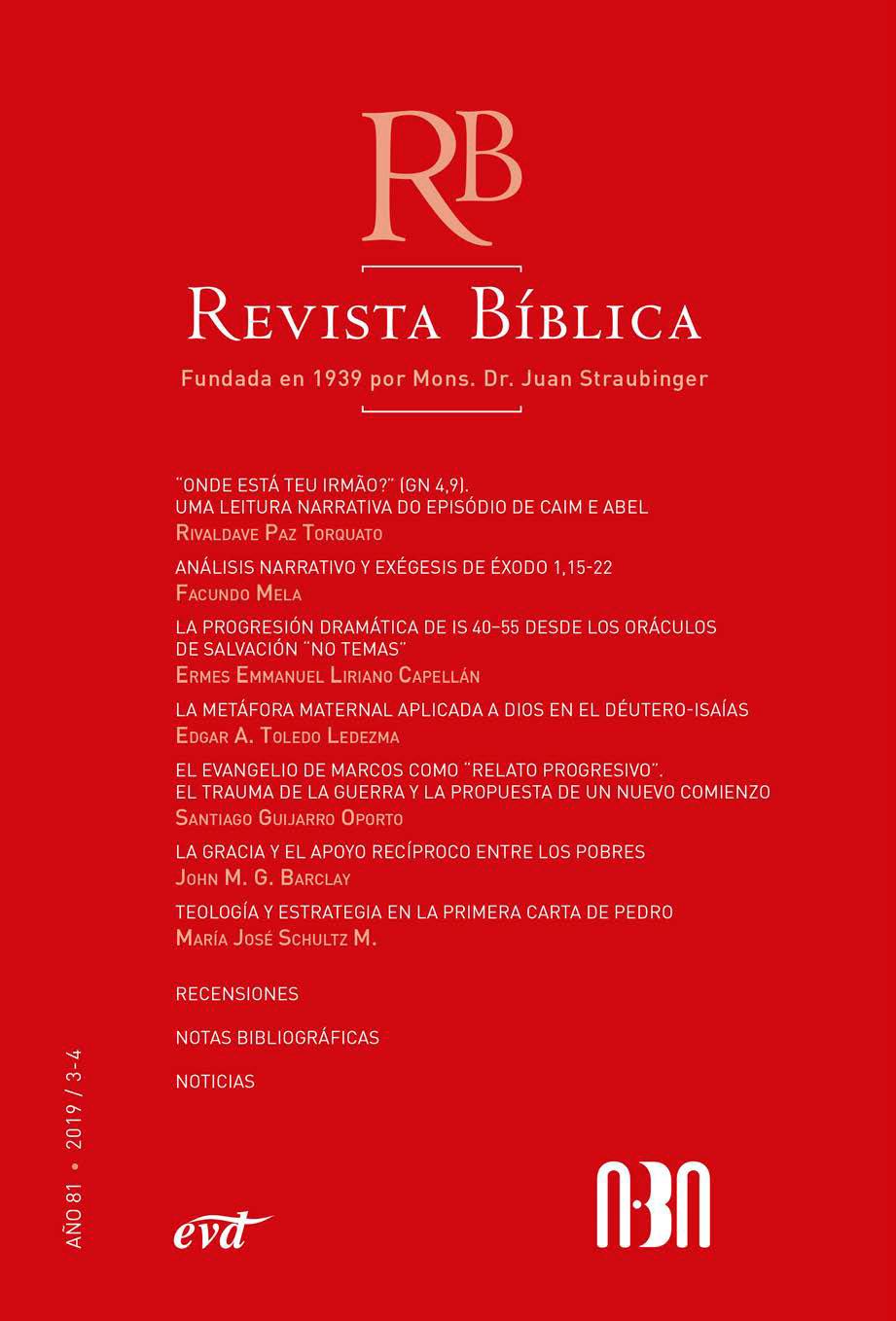
La metáfora maternal aplicada a dios en el Déutero-Isaías
DOI:
https://doi.org/10.47182/rb.81.n3-4-201991Palabras clave:
Metáfora, Maternal, Déutero-Isaías, Dramática, Retórica, Mujer, Madre, Esposa, Parturienta, Madre que amamantaResumen
El trabajo rastrea la metáfora maternal presente en el Déutero-Isaías ubicándola en un contexto dramático, para preguntarse por la función que cumple en la obra. Se realiza un recuento de las metáforas y su ubicación para analizarlas literaria y sincrónicamente. Se busca la relación entre las metáforas maternales y las otras metáforas aplicadas a Yhwh y, finalmente, se pregunta por la función retórica y dramática de las mismas.
Citas
Aletti, J.-N. et al.,Vocabulario razonado de la exégesis bíblica. Los términos, las aproximaciones, los autores (Instrumentos para el Estudio de la Biblia XV), Estella 2007.
Alonso Schökel, L. (ed.), Diccionario bíblico hebreo-español, Madrid 1994, 518.
Baltzer, K., Deutero-Isaiah. A Commentary on Isaiah 40–55 (Hermeneia. A Critical and Historical Commentary on the Bible), Minneapolis 2001.
Berges, U., The Book of Isaiah. Its Composition and Final Form (Hebrew Bible Monographs 46), Sheffield 2012.
–, Isaías. El profeta y el libro (Estudios Bíblicos 44), Estella 2011.
–, Jesaja. Das Buch und der Prophet (Biblische Gestalten 22), Leipzig 2010.
Beristáin, H., Diccionario de retórica y poética, México 1995.
Blenkinsopp, J., Isaiah 40-55. A New Translation with Introduction and Commentary (The Anchor Bible 19A), New Haven 2009.
–, El libro de Isaías (40-55) (Biblioteca de Estudios Bíblicos 148), Salamanca 2016.
Blunda, J. M., La proclamación de yhwhrey y la constitución de la comunidad postexílica. El Déutero-Isaías en relación con Salmos 96 y 98 (Analecta Biblica 186), Roma 2010.
Brown, F. – Driver, S. R. – Briggs, C., Hebrew and English Lexicon of the Old Testament, Oxford 1904.
Clifford, R. J., “Use of hôy in the Prophets”, CBQ 28 (1966) 458-464.
Coggins, R., “Isaiah”, en J. Barton – J. Muddiman (eds.), The Oxford Bible Commentary, Oxford-New York 2007.
Dille, S. J., Mixing Metaphors. God as Mother and Father in Deutero-Isaiah (Journal for the Study of the Old Testament Supplement Series 398) New York-London 2004.
Eissfeldt, O., “”, en G. J. Botterweck – H. Ringgren (eds.), Theological Dictionary of the Old Testament. I, Grand Rapids 1974, 59-72.
Garber Jr., D. G., “Trauma Theory and Biblical Studies”, CBR 14 (2015) 24-44.
Graybill, R., “Yahweh as Maternal Vampire in Second Isaiah. Reading from Violence to Fluid Possibility with Luce Irigaray”, JFSR 33 (2017) 9-25.
Gruber, M. I., “The Motherhood of God in Second Isaiah”, RB 90 (1983) 351-359.
Koehler, L. – Baumgartner, W. (eds.), The Hebrew and Aramaic Lexicon of the Old Testament, Leiden 1994-2000, 130.
Lakoff, G. – Jonhson, M., Metáforas de la vida cotidiana, Madrid 2009.
Løland, H., Silent or Salient Gender? The Interpretation of Gendered God-language in the Hebrew Bible, Exemplified in Isaiah 42, 46 and 49 (Forschungen zum Alten Testament 2. Reihe 32), Tübingen 2008.
Low, M., Mother Zion in Deutero-Isaiah. A Metaphor for Zion Theology (Studies in Biblical Literature 155), New York-Frankfurt 2013.
Marguerat, D. – Bourquin, Y., Cómo leer los relatos bíblicos. Iniciación al análisis narrativo (Presencia Teológica 106), Santander 2000.
Mondolfo, C., Daughter Zion Talks Back to the Prophets. A Dialogic Theology of the Book of Lamentations (Semeia Studies 58), Atlanta 2007.
Pagán, S., “Isaías”, en A. Levoratti (ed.), Comentario Bíblico Latinoamericano. Libros proféticos y sapienciales, II, Estella 2007.
Ramis Darder, F., Isaías 40-66 (Comentarios a la Nueva Biblia de Jerusalén), Bilbao 2008.
Riva, P., “Imágenes de yhwh como madre en la Biblia Hebrea”, Aire de Dios 28 (2014) 9-16, en http://sebip.org/airededios/28.pdf.
Schmitt, J. J., “The Motherhood of God and Zion as Mother”, RB 92 (1985) 557-569.
Sicre Díaz, J. L., Introducción al profetismo bíblico, Estella 2014, 2ª reimp.
Stuhlmüeller, C., “Déutero-Isaías”, en R. Brown – J. Fitzmyer – R. Murphy (eds.), Comentario Bíblico San Jerónimo. Antiguo Testamento, II, Madrid 1971.
Tiemeyers, L.-S., “Isaiah 40–55. A Judaite Reading Drama”, en M. J. Boda – C. J. Dempsey – L. S. Flesher (eds.), Daughter Zion. Her Portrait, Her Response, Atlanta 2012, 55-75.
Utzchneider, H., “Is there a Universal Genre of ‘Drama’? Conjectures on the Basis of ‘Dramatic’ Texts in Old Testament Prophecy, Attic Tragedy, and Egyptian Cult Plays”, en H. Liss – M. Oeming (eds.), Literary Construction of Identity in the Ancient World, Winona Lake 2010, 61-79.
Watts, J. D. W., “Isaiah 34-66”, en B. M. Metzger – D. A. Hubbard – G. W. Barker (eds.), Word Biblical Commentary, vol. 25, Nashville, 2005, ed. rev.
Westermann, C., “”, en E. Jenni - C. Westermann (eds.), Diccionario teológico manual del Antiguo Testamento, I, Madrid 1978, 527-532.
Wheelwright, P., Metáfora y realidad, Madrid 1979.
Zannoni, A. E., “Feminine language for God in the Hebrew Scriptures”, Dialogue & Alliance 2 (1988) 3-15.
Descargas
Publicado
Cómo citar
Número
Sección
Licencia
Derechos de autor 2019 Revista Bíblica

Esta obra está bajo una licencia internacional Creative Commons Atribución-NoComercial-CompartirIgual 4.0.